Credit Card Interest Explained: Everything You Need to Know
If you’ve ever looked at your credit card statement and wondered why your balance seems to be growing even though you’ve been making payments, you’re not alone.
One of the biggest causes of long-term credit card debt is misunderstanding how interest works.
Many people know that credit cards charge interest, but far fewer understand when it is charged, how it is calculated, or why it can make a balance much more expensive over time.
The good news is that once you understand the basics, credit card statements become much easier to read and your borrowing decisions become much more informed.
What Is Credit Card Interest?
Credit card interest is simply the cost of borrowing money.
Whenever you spend money using your credit card and do not repay the balance according to your card’s terms, your card provider may charge interest on the amount you still owe.
Think of it as the lender’s fee for allowing you to borrow their money.
The longer you keep a balance outstanding, the more interest may be added.
Why Do Credit Card Companies Charge Interest?
Credit card companies are lending money without asking customers to apply for a new loan every time they make a purchase.
Because they are taking on risk, they charge interest as payment for providing that credit.
This interest helps cover:
- The cost of lending money.
- Customers who never repay.
- Operating the credit card service.
- Making a profit.
Interest is therefore a normal part of how credit cards work.
What Does APR Mean?
One of the first things you’ll see on a credit card agreement is something called APR.
APR stands for Annual Percentage Rate.
It represents the yearly cost of borrowing if you carry a balance.
A card with an APR of 25% generally costs more over time than one charging 15%, assuming everything else is equal.
However, many people mistakenly think APR means exactly 25% is added every month.
That isn’t how it works.
Interest is usually calculated much more frequently, often on a daily basis, using a daily interest rate based on the APR.
How Interest Is Calculated
Although the exact calculation varies slightly between providers, the basic idea is straightforward.
Your card provider looks at:
- How much you owe.
- The interest rate on your account.
- How long the balance remains unpaid.
From that information, they calculate the amount of interest to add.
A higher balance generally means more interest.
A higher APR also increases the cost of borrowing.
Simple monthly interest estimate: Balance × APR ÷ 12. For example, a £2,000 balance at 24% APR gives an estimated monthly interest cost of about £40. Credit card providers may calculate interest daily, so the exact amount can vary depending on payments, purchases, statement dates and the card’s terms.
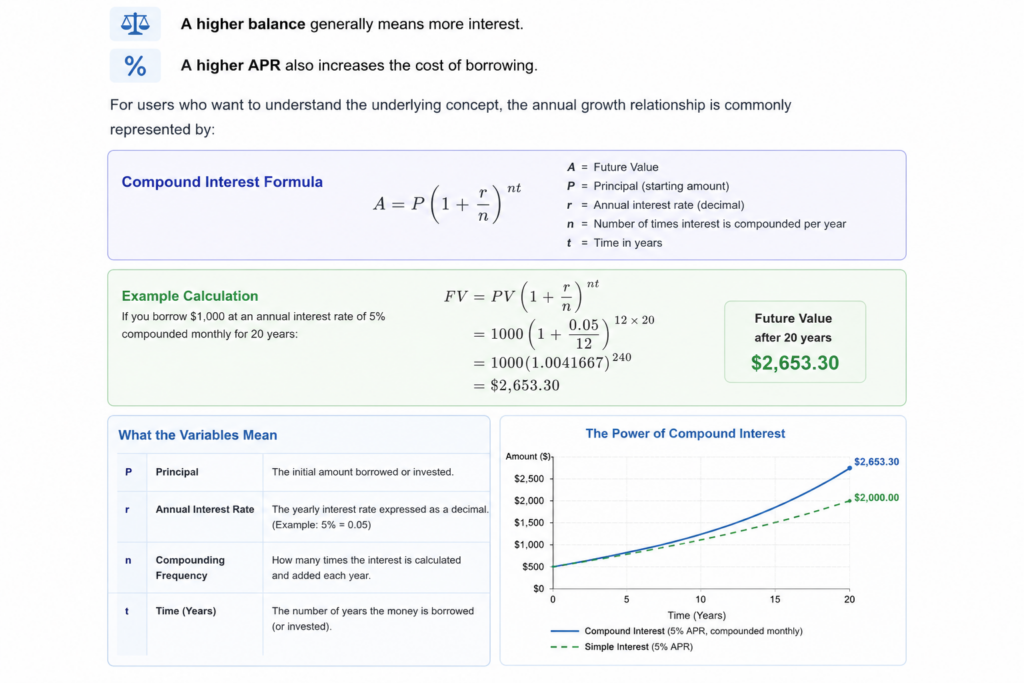
In practice, credit card issuers may calculate interest daily, but the key idea is the same: interest builds on the balance you continue to carry.
A Simple Example
Imagine you owe £2,000 on a credit card.
Your APR is 24%.
During the month, approximately £40 of interest might be added.
If you make a payment of £60, around £40 covers the interest.
Only about £20 actually reduces your debt.
This is why balances sometimes fall much more slowly than people expect.
When Is Interest Charged?
This depends on how you use your credit card.
Many cards offer an interest-free period for purchases if you pay your balance in full by the payment due date.
If you clear the balance completely every month, you may pay no interest at all on those purchases.
However, if you carry part of the balance into the following month, interest may begin to apply according to your card’s terms.
Cash withdrawals often have different rules and may begin attracting interest immediately.
Always check your card agreement to understand how your provider applies interest.
Why Small Balances Can Become Expensive
One of the biggest surprises for many people is how quickly interest adds up.
A balance of only a few thousand pounds can generate hundreds of pounds in interest over the course of a year if it remains unpaid.
The longer the balance stays on the card, the more expensive it can become.
That doesn’t mean every credit card user will face huge costs.
It simply means understanding how interest works helps you make better financial decisions.
Why Minimum Payments Slow Everything Down
Minimum payments are designed to keep your account in good standing.
They are not designed to clear debt quickly.
If your payment is only slightly higher than the interest being charged, your balance reduces very slowly.
This is why so many people feel trapped even though they make every payment on time.
Can You Avoid Paying Interest?
In many situations, yes.
Some simple habits can make a significant difference.
Pay Your Balance in Full
The easiest way to avoid purchase interest is to pay the full statement balance by the due date, where your card’s terms allow.
Pay More Than the Minimum
If you cannot clear the balance completely, paying more than the minimum usually reduces the balance faster.
More of each payment goes towards reducing what you owe instead of covering interest.
Know Your APR
Many people have no idea what interest rate their card charges.
Checking your APR helps you understand the real cost of borrowing.
Avoid Unnecessary Spending
If you’re trying to reduce debt, continuing to add new purchases makes progress more difficult.
Reducing spending while paying down the balance often speeds up repayment.
Common Myths About Credit Card Interest
“Interest is only charged if I miss a payment.”
Not necessarily.
Interest depends on your card’s terms and whether you carry a balance, not simply whether you miss a payment.
“APR tells me exactly what I’ll pay.”
APR is a useful guide to the annual borrowing cost, but the amount of interest you actually pay depends on how much you owe, how long you carry the balance and how much you repay.
“A higher payment doesn’t make much difference.”
In reality, even relatively small increases in monthly repayments can reduce both repayment time and the total interest paid.
Understanding Your Statement
Your monthly statement contains valuable information.
It usually shows:
- Your current balance.
- Your minimum payment.
- Your payment due date.
- Interest charged.
- Purchases made.
- Any fees.
- Your available credit.
Taking a few minutes to understand these figures each month can help you spot problems early.
The Bottom Line
Credit card interest is not something to fear, but it is something to understand.
The more you know about how interest works, the easier it becomes to make informed decisions about borrowing and repayment.
Whether you’re trying to clear an existing balance or simply avoid unnecessary charges in the future, understanding interest is one of the most valuable financial skills you can develop.
Knowledge allows you to stay in control rather than feeling surprised when your next statement arrives.
Continue Learning
You may also find these guides helpful:
- Minimum Payment Trap
- Balance Transfers Explained
- How to Reduce Debt
Or use one of our free tools:
- Credit Card Interest Calculator
- APR Calculator
- Debt Payoff Calculator